It was held on Monday (26), at the GEO Energética unit in Tamboara, (PR) supplying the car produced byAUDIthe A5 Sportback G-Tron model with biomethane produced by the groupACESAwith BiogasGEOENERGÉTICAobtained by recycling sugarcane residues. The meeting was promoted by theDATAGROConsulting in partnership with GEOenergética.
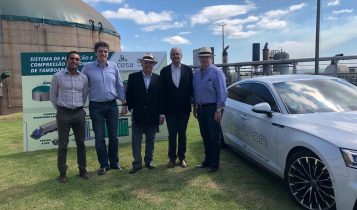
Research for the development of energy and biogas production technology from sugarcane wastes began in 2006. In partnership with Coopcana for the supply of waste, in 2011 GEO implemented its first commercial plant in a area of 10 hectares in the northwest of Paraná. This plant is already producing 4 MW of electricity, from the recycling of vinasse, filter cake, and dispatched to Companhia Paranaense and Energia Electrica (COPEL).
According to Alessadro Gardemann, director of GEO, the company plans to increase its generation capacity to 10 MW and has the potential to produce 16MW. The president of the Coopcana plant, Germano Sordi, was also present at the event and showed total enthusiasm with the new route of diversification of the sugar-energy sector. Sordi pointed out those interested in expanding the partnership with GEO / ACESA and hopes that in the near future his fleet of trucks and other machinery will be able to operate using biomethane.
At the time, Gabriel Kropsch – Director of Acesa said that biomethane is another step in the evolution of Geo Energy’s business model. “This partnership is important, not only in the production of electricity but also in the production of biomethane, so that from end to end, this residue, which in agro-industry is an environmental liability, becomes an energy asset, replacing the fossil fuel” .
The A5 is equipped with a 2.0 TFSI engine, which develops 170 horsepower and 270 Nm of torque. The newly developed engine is based on the 2.0 TFSI powered by gasoline. In the standard driving cycle, the A5 with S tronic shift utilizes only 3.8 kg of gas per 100 km run, with CO2 emissions of 102 g / km. When running on petrol, for example, the engine consumes 5.6 liters of fuel, corresponding to CO2 emissions of 126 g / km.
With these numbers, Audi aims to reduce CO2 emissions by 80%. Biomethane is produced using renewable energy from water and CO2 or from organic waste materials, such as straw weeds and plants.
Opportunity for growth –Brazil has enormous potential for the joint use of the production of biogas and biomethane and of automotive technologies that enable its utilization. In addition to modern and efficient passenger vehicles, the technology is also used in agricultural and industrial equipment that is ready for use, such as tractors, trucks and harvesters. According to ABiogás estimates, Brazil has the potential to produce 82 billion cubic meters per year of biogas. Considered the country with the largest potential for biogas production in the world, Brazil today has raw material to supply, through biogas and biomethane (purified biogas), 70% of the national consumption of diesel, or 36% of the energy consumption power. The sugar-energy sector is the great promise for biogas, with the potential to generate 41 billion m³ / year. Then comes the agroindustry with 38 billion cubic meters, and sanitation with 4 billion cubic meters.
DATAGRO sent two representatives to the event, João Otávio Figueiredo and Dr. Hermelindo de Oliveira. Both commented that with RENOVABIO, which is in the final phase of regulation, plants that use this technology will be rewarded with better efficiency grades, and consequently, economic and social gains, with the ultimate end beneficiary being the final consumer.
This text was translated by machine from Brazilian Portuguese.