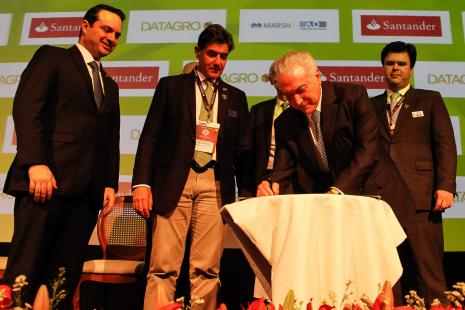
The President of the Republic, Michel Temer, signed this week, during the Opening of Sugarcane, Sugar and Ethanol 2018/19, the decree that regulates the Renewal, a program that aims to establish a long-term goal for the production of biofuels.
The text with the decree was published in the Official Gazette of today’s Union (16). Check the text in full:
THE PRESIDENT OF THE REPUBLIC, in the use of the attribution conferred by art. 84, caput, item VI, letter “a”, of the Constitution, and in view of the provisions of art. 6 of Law 13,576, of December 26, 2017, DECREES:
Article 1 The annual compulsory targets for reducing greenhouse gas emissions for the commercialization of fuels, which is dealt with in art. 6 of Law 13,576 of December 26, 2017, for a minimum period of ten years, shall be defined by the National Energy Policy Council (CNPE), in accordance with the provisions of this Decree.
Paragraph 1 The goals set forth in the caput will emphasize the improvement of the carbon intensity of the Brazilian fuel matrix and will observe:
I – the international commitments to reduce emissions of greenhouse gases assumed by Brazil and the sectoral actions under these commitments;
II – availability of biofuels by producers and importers holding the Certificate of Efficient Production of Biofuels;
III – valorisation of energy resources;
IV – the evolution of national consumption of fuels and imports;
V – the protection of consumer interests regarding the price, quality and supply of fuels; and
VI – the impact of fuel prices on inflation indices.
Paragraph 2. The Interministerial Committee on Climate Change (CIM) shall recommend annually to the CNPE the maximum limits for the compulsory goals of reducing emissions of greenhouse gases for the commercialization of fuels, with emphasis on the provisions of item I of paragraph 1 , defined by the proportionality of the effort to reduce emissions in the various sectors of the economy.
Paragraph 3. The RenovaBio Committee, established in art. 2, it shall recommend annually to the CNPE the maximum limits for the compulsory emission reduction targets of greenhouse gases for the commercialization of fuels, with emphasis on the provisions of items I to VI of §1.
Art. 2 The RenovaBio Committee is hereby established, within the scope of the Ministry of Mines and Energy, composed of representatives, head and deputy, of the following organs:
I – Ministry of Mines and Energy;
II – Civil House of the Presidency of the Republic;
III – Ministry of Finance;
IV – Ministry of Agriculture, Livestock and Supply;
V – Ministry of Industry, Foreign Trade and Services;
VI – Ministry of Planning, Development and Management; and
VII – Ministry of the Environment.
§ 1 The coordination of the RenovaBio Committee may invite representatives of federal, state and municipal public administration bodies from public and private entities of the biofuels market, technicians and specialists from the sector to attend its meetings.
Paragraph 2. The expenses related to the participation of representatives and guests shall be borne by the budget appropriations of the institutions they represent.
Paragraph 3. Participation in the RenovaBio Committee shall be considered a relevant public service, not remunerated.
Art. 3 – The Renewable Energy Committee, in compliance with the objectives and foundations of the National Biofuels Policy, pursuant to the provisions of art. 1 and in art. 2 of Law 13,576, of 2017:
I – monitor the supply and development of biofuels production and market, taking into account their importance for the regularity of fuel supply;
II – to monitor the evolution of biofuel production capacity holding a Certificate of Efficient Production of Biofuels;
III – to monitor the supply, demand and prices of decarbonisation credits – CBios issued and traded from the biofuels market;
IV – prepare analyzes and studies, directly or through contracting or agreement, that will serve as the basis for the determination of scenarios and projections that will support the definition of the goals set forth in art. 1st;
V – carry out prior public consultation, in accordance with the provisions of art. 12 of Law 13,576, of 2017, to recommend to CNPE the provisions of paragraph 3 of art. 1st; VI – systematically monitoring and disseminating, preferably in an official website, the evolution of the carbon intensity index of the Brazilian fuel matrix, in comparison with the annual compulsory greenhouse gas emission reduction targets and respective tolerance intervals;
VII – evaluate and propose preventive or corrective measures for the adequate fulfillment of the goals set forth in art. 1st; and VIII – to prepare and approve its bylaws.
Paragraph 1 The annual compulsory greenhouse gas emission reduction targets shall be set in CBios units and shall be defined based on the projected carbon intensity for the subsequent 10-year period.
§ 2 Each decarbonization credit unit shall correspond to one ton of carbon dioxide equivalent, obtained from the difference between the greenhouse gas emissions in the life cycle of a biofuel and the emissions in the life cycle of its substitute fossil fuel, estimated according to procedures and criteria adopted for the Certification of Biofuels.
Art. 4 The RenovaBio Committee shall publicize the minutes of meetings, studies and technical notes prepared within the Committee, preferably on an official website.
Art. 5 The compulsory goal of which the caput of art. 1 will be deployed by the National Petroleum Agency, Natural Gas and Biofuels – ANP, for each current year, in individual targets, applied to all fuel distributors, proportional to their respective market share in the commercialization of fossil fuels in the previous year.
Art. 6 The proof of attendance to the individual target will be made annually by the fuel distributor, under the terms established by the ANP.
Article 7 In the event of non-partial or full compliance with the individual target, the fuel distributor shall be subject to a fine, to be applied by the ANP, in proportion to the noncompliance, without prejudice to administrative and pecuniary sanctions and of a civil and criminal nature.
Paragraph 1 – The fine shall be equivalent to the value of the CBios not acquired, considered the highest monthly average of CBio’s quotations in the non-compliance exercise.
Paragraph 2 Under Paragraph 1, in the event that the value obtained is:
I – less than R $ 100,000.00 (one hundred thousand reais), this amount is applied as a fine;
II – in excess of R $ 50,000,000.00 (fifty million reais), this amount shall be applied as a fine. Paragraph 3. The fine of each distributor may not exceed five percent of its annual revenue recorded in the balance of the two previous years, except for the hypothesis of item I of § 2.
Art. 8 The CNPE may authorize the reduction of the individual target of the fuel distributor, foreseen in art. 8 of Law 13,576, of 2017, when proven the acquisition of biofuels through a long-term supply contract.
Single paragraph. The reduction referred to in the caput may not exceed 20% (twenty percent).
Article 9. The ANP shall annually publish the percentage of attendance to the individual target by each fuel distributor and the respective administrative and pecuniary sanctions applied.
Article 10. The ANP shall establish, in its own regulations, the criteria, procedures and responsibilities for the regulation and supervision of biofuels certification, which shall include, among others:
I – accreditation, suspension and cancellation of the registration of inspecting firms;
II – concession, renewal, suspension and cancellation of the Certificate of Efficient Production of Biofuels; and
III – emission of the Energetic-Environmental Efficiency Note.
Single paragraph. In accordance with the provisions of Law No. 9,478 of August 6, 1997, the ANP will regulate as new biofuel species, in addition to biodiesel and ethanol, other substances derived from renewable biomass, as well as biofuels and biofuels, in liquid, solid or gaseous state, which may be used, directly or by modification, in internal combustion engines or for other types of energy generation, with a view to the partial or total replacement of fossil fuels.
Article 11. The annual compulsory greenhouse gas emission reduction targets for the commercialization of fuels shall be defined until June 15, 2018, to be in effect from June 24, 2018 to December 31, 2028.
Art. 12. The individual compulsory goals referred to in art. 7 of Law 13,576 of 2017, applicable to all fuel distributors, shall be defined and made public until July 1, 2019, to be effective as of December 24, 2019.
MICHEL TEMER
Fernando Coelho Filho
(Official Gazette of the Union, March 16, 2018, pages 2-3)