The total useful capacity available in Brazil for agricultural storage in the first semester of 2018, in establishments active in the research of the Brazilian Institute of Geography and Statistics (IBGE), was 169 million tons, a result 1.2% higher than the second semester of 2017 (167 million tonnes). Mato Grosso obtained the largest storage capacity, with 40.2 million tons.
Silos
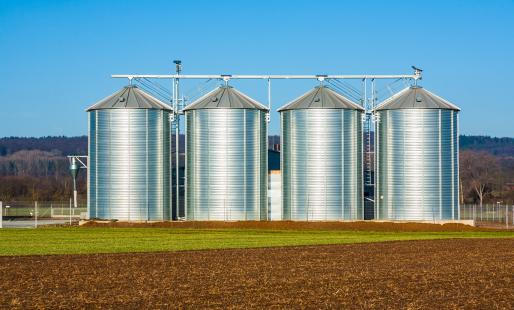
In terms of usable storage capacity, silos predominated, reaching 81.1 million tons in the first half of 2018, corresponding to 48.0% of total useful capacity. In relation to the previous semester, the silos increased by 3.0%. Then, the bulk and bulk warehouses, responsible for 37.6% of the national storage, reached 63.6 million tons of storable working capacity, presenting growth of 0.8%. Conventional, structural and inflatable warehouses totaled 24.3 million tons, a decrease of 3.3% compared to the second half of 2017.
With 7,733 active establishments in the first half of 2018, Inventory Survey showed a decrease of 0.5% when compared to the survey of the second half of 2017. In the first half of 2018, the Central-West Region was the only one that had a small increase in the number of active establishments (0.1%), while the Southeast Region had the largest drop (2.4%).
Stocks
Agricultural inventories totaled 58.3 million tonnes, down from 58.7 million tonnes in the first half of 2017. In the first half of 2017, soybean and rice inventories increased by 6% and 0.5%, respectively, while corn declined 17.7%. Soybean inventories accounted for the largest volume (37 million tonnes), followed by stocks of maize (10.7 million), rice (4.9 million), wheat (2 million) and coffee (762.0 thousand tonnes).
These products corresponded to 94.9% of the mass of grain stored between the products monitored by the research, the remaining 5.1% being composed of cotton, black beans, beans and other grains and seeds.
This text was translated by machine from Brazilian Portuguese.